
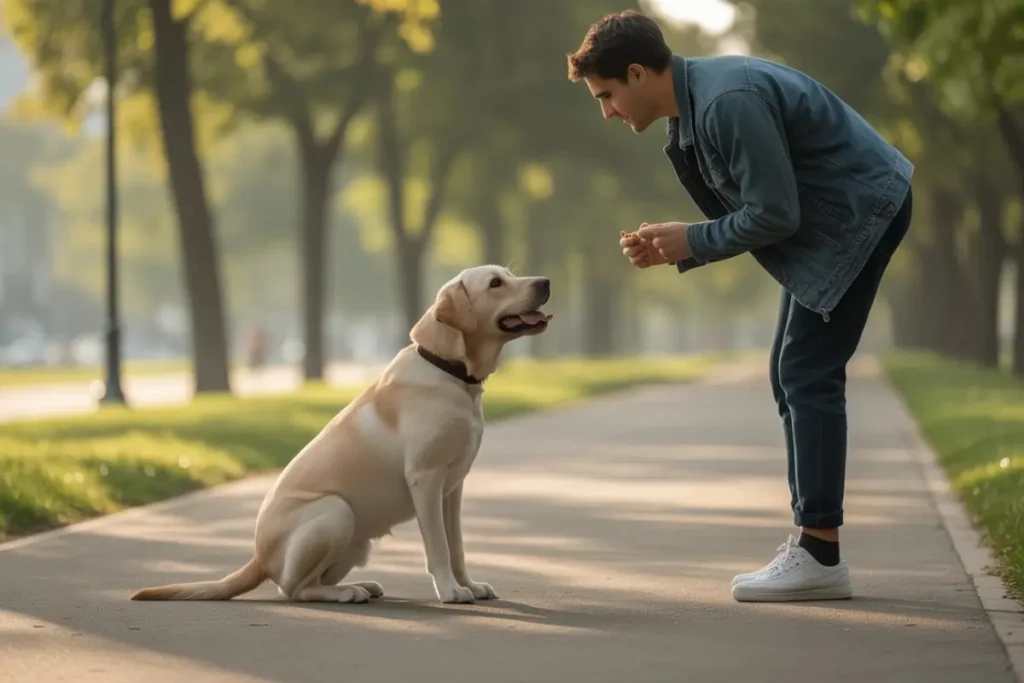
I’ll never forget the first time I met Harley — a one-year-old Labrador whose energy could light up an entire room… or wreck it in seconds. His owner, Sarah, greeted me at the door looking exhausted.
“He’s a good boy,” she sighed, “but he just can’t stop moving.”
Harley wasn’t aggressive or defiant — he was simply unfocused. His heart wanted to please, but his body didn’t know how to slow down. And that’s exactly where calm and focused dog training comes in.
This kind of training isn’t about obedience drills or dominance. It’s about teaching your dog to balance energy — to think before reacting, to listen before leaping. It’s what transforms chaos into communication and frustration into harmony.
If you’ve ever looked at your bouncing, barking, spinning pup and wondered, “Will he ever chill?” — this guide is for you.
What Calm and Focused Dog Training Really Means
Let’s start with what this method isn’t.
Calm and focused dog training isn’t about making your dog submissive or emotionless. It’s not a “shut down and obey” style. Instead, it’s a mindful approach that builds emotional balance and clear thinking in your dog.
When your dog learns to stay calm, they begin to:
- Listen better, even around distractions.
- React slower, which means less reactivity or fear.
- Feel safer and more connected to you.
It’s like helping a child learn self-control — not through fear, but through confidence.
Calm Training Is Emotional Training
A hyper or anxious dog isn’t “bad”; they’re often overwhelmed.
Think of it this way: dogs experience the world through senses — smell, sound, and movement. Without structure, the world feels chaotic. The calm and focused dog training method helps your dog filter that chaos, giving them tools to stay grounded.
We don’t just want a dog that listens when we shout; we want a dog that chooses focus because they trust our lead.
Calm is not the absence of energy — it’s the mastery of it.
When your dog learns to control their impulses, you unlock a deeper level of understanding — one built on patience and emotional awareness.
Why Calm and Focused Training Matters More Than Ever
Modern life is noisy — cars, screens, doorbells, delivery people, and endless stimulation. Dogs today face a constant flood of sounds, sights, and smells that can easily overwhelm their nervous system.
This is why calm and focused dog training isn’t a luxury — it’s essential.
1. It Builds a Safe and Reliable Dog
A calm dog is a safe dog. Whether in public or at home, a dog who can focus under pressure won’t lunge, bolt, or overreact.
If you’ve ever tried to walk a hyper dog through a crowded street, you know how stressful it can be. With consistent calm training, your dog learns to look at you first — not at every noise or motion around them. That simple pause can prevent accidents, fights, or panic.
2. It Deepens the Bond Between You and Your Dog
When your dog trusts you to lead them through excitement, fear, or distraction, your relationship transforms. You’re no longer just their owner — you become their anchor.
Calm and focused dog training creates a partnership based on clarity, not conflict. Your dog learns:
“When I’m unsure, I can look to you.”
And that’s one of the most powerful connections you’ll ever build.
3. It Reduces Behavioral Issues
Most “bad” behaviors — jumping, pulling, barking, chewing — stem from overstimulation and lack of focus. When you teach calmness, those problems begin to fade on their own.
You’re not constantly correcting symptoms; you’re addressing the root cause: lack of mental balance.
A calm dog thinks before acting.
A focused dog learns faster.
Together, they become the dog you’ve always dreamed of living with.
4. It Creates Confidence in Anxious Dogs
Anxiety in dogs often looks like hyperactivity — pacing, whining, spinning, or barking. But underneath that energy is fear.
Through calm training, dogs learn that stillness is safe.
They begin to trust quiet moments instead of fearing them.
This shift changes everything — it builds emotional stability from the inside out.
5. It Helps YOU Stay Calm Too
Here’s the secret no one tells you: calm training isn’t just for your dog.
When you learn to communicate through patience, body language, and steady energy, you become calmer too.
Dogs mirror us.
When you breathe deeply, slow your voice, and center your body, your dog does the same.
Calm leadership begins with calm presence.
That’s why calm and focused dog training is as much about your own growth as it is about your dog’s.
Understanding the Science of Calmness
Dogs have an incredible ability to read human emotions. They can smell adrenaline, sense tension in your voice, and even pick up on subtle posture changes.
When we stay tense, our dogs stay alert. When we relax, their heartbeat slows too.
This emotional feedback loop is the foundation of calm and focused dog training.
Through consistent structure and tone, your dog begins to synchronize with you emotionally — much like two dancers moving in rhythm.
That’s why even small things — like lowering your shoulders or softening your tone — can influence how your dog behaves.
How Calmness Translates Into Focus
Focus isn’t just about attention; it’s about emotional stability.
When a dog feels calm, their brain shifts from survival mode to learning mode.
In this state, your dog can:
- Process commands faster.
- Retain lessons longer.
- React to distractions with composure.
It’s the same as trying to learn something while you’re anxious — impossible. Once calm, clarity comes naturally.
The Balance Between Calm and Drive
It’s important to remember that calm training doesn’t mean suppressing drive. A dog still needs enthusiasm and play. The goal is to channel that energy rather than extinguish it.
For example:
- During fetch, your dog learns to sit calmly before each throw.
- Before mealtime, they wait for your signal instead of jumping.
- On walks, they follow your pace instead of dragging you.
That’s not control — it’s cooperation.
When drive and discipline meet balance, that’s where greatness begins.
How This Sets the Stage for Success
Now that we’ve built the emotional foundation — understanding what calm and focused dog training means and why it’s essential — we’re ready for the fun part: implementation.
In the next section, we’ll dive into the practical framework — the daily structure, step-by-step guide, and proven methods to transform your dog from restless to relaxed, from distracted to disciplined.
Your Daily Dog Training Routine for Calm and Focus
Here’s something I tell every client I’ve coached over the past 25 years — dogs don’t become calm by accident.
They become calm through consistency.
A great calm and focused dog training plan doesn’t happen in one marathon session. It’s built through simple, steady, daily habits that tell your dog:
“You can count on me. We do this together, every day.”
Let’s break down what an effective daily dog training routine looks like.
Morning: Start the Day with Centered Energy
Morning sets the emotional tone for your dog’s entire day.
Avoid the chaotic “rush to the door” energy. Instead:
- Begin with quiet connection.
Sit or kneel beside your dog, place a hand on their shoulder, and breathe slowly for 30 seconds. This signals calm from the start. - Structured walk (15–30 minutes).
Walks aren’t just potty breaks — they’re moving meditations. Keep the leash short but relaxed. If your dog pulls, stop, wait, then resume calmly. - Short focus exercise.
Before feeding, ask for a simple command like “sit” or “down.” This teaches your dog patience and awareness even when excited about food.
Consistency in these first 20 minutes teaches impulse control naturally.
Midday: Energy Channeling Through Play and Focus
Dogs need to release energy — but structure matters.
Use play sessions to reinforce focus instead of frenzy.
- During fetch, have your dog wait calmly before you throw the toy.
- During tug, pause periodically and ask for “drop it” or “sit.”
- Reward focus, not intensity.
These moments teach your dog that calm earns more fun. That’s the psychology behind calm and focused dog training — controlled excitement, guided by trust.
Evening: Wind-Down Routine
Evenings are for resetting and relaxation.
Here’s a powerful habit I’ve seen change behavior overnight:
- Quiet time before bed.
Turn off loud TV, dim lights, and have your dog settle near you. - Use calm reinforcement: soft strokes, gentle tone, slow breathing.
- If your dog’s still restless, a five-minute “place” exercise works wonders — ask them to lie on a mat calmly until released.
Over time, this becomes their “off switch.”
Calmness isn’t trained once — it’s woven into every routine.
Step-by-Step Guide to Calm and Focused Dog Training
Let’s get practical now.
Here’s how to turn the concept of calm and focused dog training into real-life, actionable steps.
Step 1: Teach Calmness Through Stillness
Start small. Have your dog sit or lie down for short intervals. Reward quiet, relaxed posture — not hyper attention.
If they fidget or break position, simply reset them without emotion.
This teaches that calm is the behavior that earns success.
Pro tip: Always wait for relaxation before reward — not just obedience. A still body and soft eyes mean true calm.
Step 2: Strengthen Focus With Eye Contact
Focus starts with connection.
Hold a treat near your eyes and say your dog’s name. When they look at you — even for half a second — mark it with a “yes!” and reward.
Repeat multiple times a day. Gradually extend the duration.
Soon, you’ll notice your dog automatically checking in with you in distracting environments — that’s real focus.
Step 3: Practice Controlled Exposure to Distractions
Calmness means nothing if it only works in silence.
Introduce mild distractions:
- Toys on the floor.
- Someone walking nearby.
- Background noises or birds.
Reward your dog for ignoring them and maintaining attention.
This is a cornerstone of calm and focused dog training — teaching the dog that excitement can exist without reaction.
Step 4: Teach the “Settle” Command
“Settle” means your dog learns to relax on cue.
Use it when guests arrive, when you’re on a call, or before bedtime.
- Ask your dog to lie on a mat.
- Say “settle” in a calm, low tone.
- Reward every few seconds of relaxed stillness.
Within days, your dog associates “settle” with peaceful energy.
Step 5: Transition Calmness Into Real-World Situations
Once your dog can stay calm at home, it’s time to generalize.
- Take short walks in busier areas.
- Practice focus around other dogs.
- Visit parks, patios, or stores that allow dogs.
Start with brief sessions and gradually lengthen exposure.
Your goal isn’t perfection — it’s progress through trust.
How to Train a Hyper Puppy to Be Calm
Puppies are pure energy. But that’s not a problem — it’s potential waiting for direction.
Here’s how to adapt calm and focused dog training for young dogs:
- Keep sessions under 5 minutes; puppies tire quickly.
- Avoid over-exciting tones — use gentle praise.
- Reinforce calm play, not chaos.
- Use short naps between sessions — calmness grows from rest too.
Patience here pays lifelong dividends. Puppies raised on structure become adults who handle life gracefully.
Motivation Tips for Overly Energetic Dogs
Some dogs are born with motors that never quit — Border Collies, Shepherds, Labs, Terriers. You can’t out-energy them; you must out-focus them.
These methods help channel energy productively:
- Train Before Meals — Hungry dogs are attentive learners.
- Incorporate Nose Work — Scent games drain mental energy faster than fetch.
- Use Food Puzzles — Slows down eating and encourages problem-solving.
- Alternate Physical and Mental Drills — A walk followed by focus training creates balance.
What to Avoid When Training Energetic Dogs
Don’t try to “wear them out” with endless fetch — it increases stamina, not calmness.
Don’t scold or shout — it fuels adrenaline.
Do reward stillness, slow breathing, and eye contact.
Remember: calm isn’t the opposite of fun — it’s what makes fun sustainable.
Balancing Calm and Excitement
Some owners worry that calm training will make their dogs “boring.”
Quite the opposite.
When your dog learns control, their joy becomes purer. They play harder, listen better, and recover faster from excitement.
It’s like teaching a child to handle sugar — the goal isn’t no fun, it’s balanced fun.
That’s why calm and focused dog training works for every lifestyle — from therapy dogs to family pets to high-energy working breeds.
Common Mistakes That Undermine Calm and Focused Dog Training
Even with the best intentions, many owners unknowingly sabotage progress. The beauty of calm and focused dog training is that every mistake becomes a learning opportunity — for both dog and human.
Let’s look at the seven most common mistakes I’ve seen in real homes and classes, and how to turn them around.
1. Training When the Dog Is Overstimulated
Trying to teach calm behavior when your dog is already bouncing off the walls is like trying to meditate during a rock concert.
Fix:
Set your dog up for success. Begin training sessions after mild exercise or a walk. A little physical release clears the mind for focus.
Calmness isn’t created in chaos — it’s built from balance.
2. Inconsistent Leadership
One day you let your dog jump on the couch; the next, you scold them for it. Mixed messages confuse dogs and create anxiety.
Fix:
Decide on the boundaries before training begins and stick to them. Consistency equals security — and security breeds calmness.
3. Relying on Commands Without Emotion
You can’t fake calm. If you bark “sit” while you’re frustrated, your dog feels that energy more than the word itself.
Fix:
Focus on how you communicate, not just what you say.
Use tone, timing, and relaxed posture as your most powerful tools.
4. Overusing Treats or Rewards
Food is a great motivator — but too much of it turns obedience into dependency.
Fix:
Gradually replace treats with real-life rewards: praise, affection, play, and freedom. Dogs trained this way obey out of respect, not expectation.
5. Skipping Mental Enrichment
Owners often assume that physical exercise alone creates a calm dog. But tired muscles don’t equal a balanced mind.
Fix:
Add problem-solving games, scent work, or trick training.
Ten minutes of mental challenge can equal an hour of physical play in terms of focus-building.
6. Losing Patience Too Quickly
Calm training takes time — weeks, not days.
Your dog might regress, test limits, or have off days. That’s okay.
Fix:
Track small wins. Keep a simple journal noting moments your dog chose calmness on their own — those are your milestones.
7. Forgetting to Work on Yourself
Here’s the truth few trainers will say out loud: calm training starts with the human.
If you’re anxious, angry, or impatient, your dog will mirror that energy.
Fix:
Before every session, pause. Take a breath. Reset your tone.
Your emotional stability is the best training tool you’ll ever own.
The Emotional Benefits of Calm and Focused Training
This kind of training goes far beyond obedience. It shapes a dog’s confidence, deepens emotional connection, and improves daily life for both of you.
1. You Build Unshakable Trust
When your dog learns to stay calm under pressure, it’s not just skill — it’s trust in you.
They know that your presence means safety, and that changes their entire worldview.
A focused dog no longer scans for threats — they look to you.
2. You Create Emotional Balance
Calm and focused dog training helps balance the nervous system.
Dogs prone to stress or overarousal start to regulate naturally, sleeping deeper and reacting less to triggers.
That balance extends to you, too. Many of my clients tell me their dogs’ calmness improved their mood, patience, and even sleep quality.
3. You Strengthen Nonverbal Communication
When your dog learns to mirror your energy, verbal commands become secondary. You’ll find yourself using fewer words and more gestures — a true silent language between companions.
That’s not obedience; that’s understanding.
4. You Experience More Freedom Together
A calm and focused dog can go anywhere — parks, cafes, road trips — without chaos or stress.
You’re not managing behavior; you’re enjoying life side by side.
That’s the ultimate goal of calm and focused dog training: peace that travels with you.

Frequently Asked Questions (FAQ)
1. How long does calm and focused dog training take?
It depends on your dog’s personality and consistency.
Most owners see improvement in 2–4 weeks, but true emotional balance builds over months of routine and reinforcement.
2. Can I use calm training with rescue or anxious dogs?
Absolutely. It’s one of the best approaches for rescues.
It replaces fear with trust through predictability and gentle communication.
3. Is calm training suitable for high-energy breeds?
Yes — it’s essential for them! Breeds like Border Collies or Huskies need structured outlets for energy, not constant activity. Calm training teaches control without suppression.
4. Should I ignore bad behavior or correct it?
Neither extreme works alone.
Calm correction (like redirection or resetting) works better than shouting or ignoring. The goal is guidance, not punishment.
5. What if my dog only listens at home, not outside?
That’s a focus issue. Gradually increase environmental distractions — practice in your yard, then near sidewalks, then at parks.
Consistency builds reliability anywhere.
6. Can calm training help with barking or jumping?
Yes — because those behaviors stem from overexcitement.
When dogs learn emotional regulation through calm and focused dog training, excessive barking or jumping fades naturally.
7. Do I need professional help to train calmness?
If you’re consistent, no. Many owners succeed at home using daily structure, patience, and empathy.
But a certified trainer can accelerate progress if your dog struggles with reactivity or fear.
Final Thoughts: The Art of Stillness and Connection
If there’s one thing I’ve learned after decades in the field, it’s this — calmness is contagious.
When you stay grounded, your dog feels it. When you breathe slowly, your dog’s heartbeat follows yours.
That’s the invisible thread that calm and focused dog training weaves between human and animal: shared peace.
You’re not just training a dog — you’re building emotional fluency between two species that choose to understand each other.
So next time your dog gets distracted or bounces with energy, don’t get frustrated. Smile, take a breath, and start again.
Each repetition is another step toward the quiet confidence you both deserve.
And one day, without realizing it, you’ll notice your dog sitting calmly beside you in the middle of life’s noise — not because they’re forced to, but because they trust you enough to rest there.
That’s not obedience.
That’s harmony.
That’s love, trained through patience and presence.