
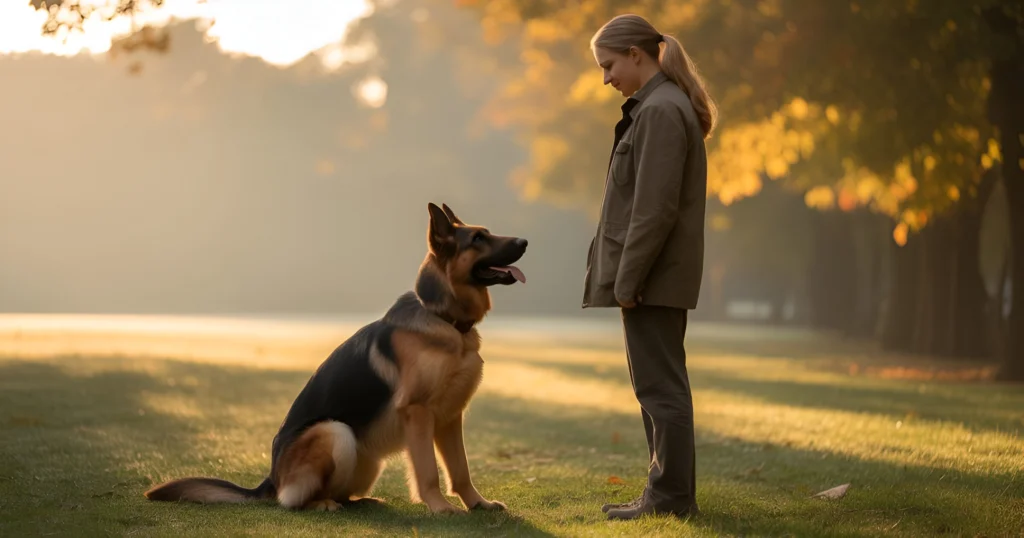
I still remember the first time I asked a young German Shepherd named Max to stay. The park was quiet, the air a little crisp, and Max’s eyes kept cutting toward a squirrel flicking its tail like a tiny metronome of chaos. I took a breath, softened my knees, lifted my hand, and said one word—“Bleib.” For half a heartbeat, he nailed it. Then his rear wiggled, his paws skated forward, and—poof—he became a rocket with fur.
I didn’t scold him. I smiled. Because that’s when it hit me: teaching stay in german dog commands isn’t about freezing a dog in place; it’s about creating calm in motion—a moment where your dog believes your guidance is more important than the noise of the world. When Max finally held that stay while a jogger passed, I realized we weren’t just training obedience; we were building trust. And that trust, not the syllables, is what changes everything.
This guide is my one-on-one conversation with you—no fluff, no gimmicks. You’ll learn why the German cue “Bleib” can feel clearer than English “stay,” how to teach it step by step, and how to weave it into daily life so it becomes a reflex you both can count on.
What “stay” means (and why German helps)
“Stay” in German is “Bleib” (pronounced blybe). You’ll often hear it alongside Sitz (sit) and Platz (down) in many German dog training commands programs. Is German magical? No. But it is distinctive, and that’s a big deal.
Three reasons German shines:
- Clarity of sound. “Bleib” doesn’t pop up in normal household chatter, which means your cue stays “clean.”
- Focus for you. Using stay in german dog commands nudges you to slow down, choose your tone, and be intentional—skills your dog can feel.
- A proven tradition. From working K9 units to sport obedience, german dog commands have a long record of crisp communication and consistency.
If you already use English cues, you can still switch. Or keep both—just be consistent. Many handlers use Sitz for sit in German for dogs, Bleib for stay, and English recall. What matters is that you pick a system and stick with it.
Why it matters (beyond obedience)
The most underappreciated skill in dog training is impulse control. “Stay” is the gateway. It’s the difference between a dog that darts through a door and a dog that glances at you first. It’s the difference between a leash yanked tight and a leash that droops like a smile.
When you practice stay in german dog commands, your dog learns:
- Patience: “I can wait even if I want to move.”
- Emotional regulation: “I can feel excited and still stay connected to you.”
- Safety: “I freeze now because I trust you’ll tell me when it’s safe.”
If you’ve ever wished your dog would “just hold it together,” Bleib is how you teach them to do exactly that.
Step-by-step guide (clear, calm, and proven)
Goal: build a reliable stay in german dog commands routine that holds up in real life.
Setup essentials
- Environment: start quiet—living room, hallway, or fenced yard.
- Reinforcers: soft, pea-sized treats; praise; short play bursts.
- Body language: relaxed shoulders, gentle face, steady breathing.
- Release word: pick one (e.g., “Frei!” meaning “free,” or “Okay!”).
Step 1: Create the position
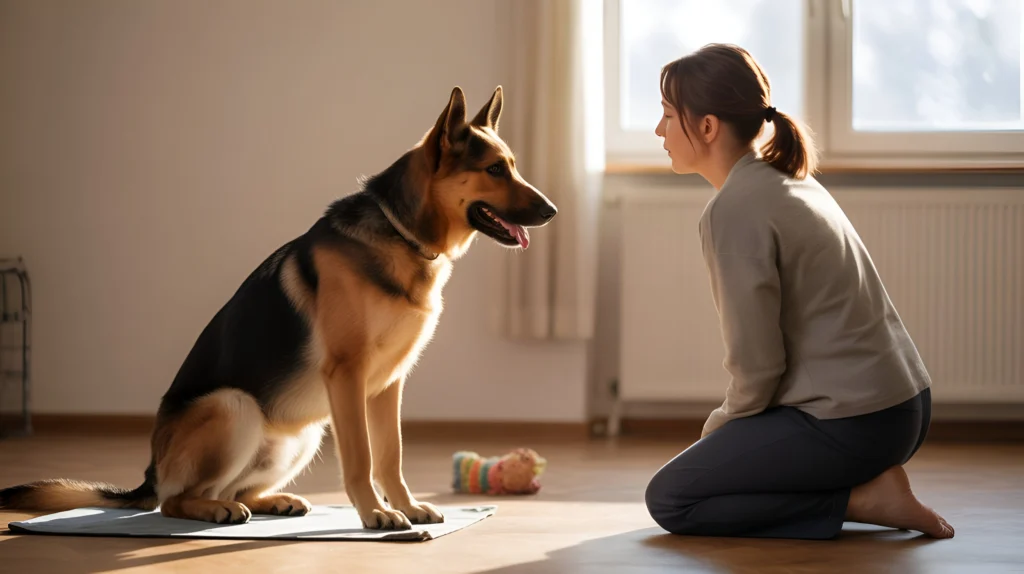
Ask for Sitz (sit in German for dogs). As your dog settles, show a raised palm like a stop sign and say “Bleib.” Count “one-one-thousand,” then step in, reward, and release with your chosen word. Your first wins are tiny. That’s intentional.
Step 2: Build duration
Work a ladder: 1s → 3s → 5s → 8s → 12s. If your dog breaks, don’t punish—just reset. The lesson is “try again,” not “you failed.” Keep reps short and upbeat. Sprinkle the phrase stay in german dog commands into your self-talk: you’re not bribing; you’re building understanding.
Step 3: Add distance
From your starting spot, give “Bleib” and take one slow step back. Return, reward, release. Then two steps. Then three. Use a loose leash dropped on the floor as a visual boundary if your dog creeps. Dogs love lines—they make staying easier.
Step 4: Add mild distractions
While your dog holds Bleib, wave one hand, take a side-step, or place a toy on the floor off to the side. Mark and reward stillness. The game is “notice the world, choose to stay.” This is where stay in german dog commands starts feeling like a superpower.
Step 5: Add moderate distractions
Now try jingling keys, a door opening, a friend walking past. If your dog breaks, calmly guide them back, ask for Sitz, cue “Bleib,” and cut the difficulty in half. One step forward, two steps back is normal.
Step 6: Generalize to locations
Doorways before walks. Kitchen before meals. Sidewalks before crossing. Park benches with birds nearby. Each new place is a “first time” for your dog; restart the ladder briefly, then stretch.
Step 7: Introduce the down-stay
Once sit-stay is stable, teach Platz (down) and then Bleib in that posture. Many dogs find down-stay more relaxing for longer durations. You’re adding a second “gear” to stay in german dog commands—very useful for cafés, patios, and polite company.
Step 8: Fade food, keep the feelings
Gradually replace treats with praise, gentle touch, or the release itself. The aim is for your dog to value the state of staying—calm attention—more than the currency. That’s when stay in german dog commands becomes part of your shared language, not a transaction.
Mini progress table
| Stage | What you do | What your dog learns |
| Duration | Hold 1→12 seconds | “Stillness can last.” |
| Distance | Step back 1→3→5 steps | “You can move; I remain.” |
| Distraction | Add sight/sound scents | “I can feel & choose.” |
| Generalize | New rooms/outdoors | “Bleib means the same everywhere.” |
| Down-Stay | Add Platz + Bleib | “Relaxed staying is easy.” |
Common early fixes
- Dog creeps forward? Use a floor marker (leash or mat). Reward staying on the marker.
- Dog pops up at release word? Perfect—that’s clarity. If they leave early, you released too late last rep; shorten duration, then rebuild.
Dog ignores “Bleib” outside? You changed the environment; reset the ladder. A 3-second win outside beats a 30-second fail.
Where other languages fit (briefly)
If you’ve trained with Dutch dog commands before (common in KNPV traditions), the same principles apply. You can mix languages—many handlers do—but consistency beats novelty. If your dog already recognizes Sitz or Platz, keep them. Layering stay in german dog commands on top of solid basics is smoother than reinventing everything.
The emotional payoff (sneak peek)
As you practice, watch for tiny shifts: a slower blink, a softer jaw, an exhale you can hear. That’s your dog learning to regulate themselves in your presence. That’s what stay in german dog commands builds—self-control powered by trust. In Part 2, we’ll supercharge motivation, tackle advanced challenges, fix the most common mistakes, answer real-owner questions, and land this plane with simple, powerful takeaways.
Motivation tips for “stubborn” dogs (spoiler: they’re usually thoughtful)
Some dogs aren’t defiant; they’re discerning. They ask, “Is this worth it?” Your job is to make Bleib feel rewarding, clear, and fair.
Five ways to unlock buy-in:
- Short sessions, big wins. Work in 3–5 minute bursts. End on success, not fatigue.
- Right currency. Some dogs will sprint for chicken; others light up for a tug toy or a chance to sniff. Pay in the coin your dog values.
- Calm energy. If your voice tightens, your dog mirrors it. Smooth tone + slow breath = steadier stay in german dog commands.
- Choice and control. Ask for a 3-second Bleib, then release to a favorite activity. Teach them that staying earns freedom.
- Train the “easy wins.” Doorway stays, mealtime stays, curbside stays. Real-life reps make the behavior meaningful and sticky.
A quick story: Daisy, a Labrador with the attention span of a confetti cannon, became a champion of stay in german dog commands when we used her obsession—tennis balls—as payment. Three seconds of Bleib, then “Frei!” and a rolling ball. Within a week she could hold 20 seconds while the ball sat in plain sight. Motivation isn’t bribery; it’s clarity through value.
Advanced challenges (when you’re ready to level up)
You’ve got duration, distance, and basic distractions. Let’s turn stay in german dog commands into a life skill under pressure.
1) Out-of-sight stay
Cue Bleib, step around a doorway for 2 seconds, return, reward, release. Build to 10–15 seconds. Use a baby monitor or mirror to peek if needed—don’t let your dog practice breaking.
2) Public patio stay
Start with Platz-Bleib (down-stay). Reward calm scanning. Keep sessions short and end before your dog frays. This is the moment where german dog commands shine; the words cut through clatter.
3) Motion stay
You walk, hop, even jog in place while your dog holds Bleib. Mark and reward relaxation, not just position. The lesson is “your movement doesn’t move me.”
4) Long-line park stay
Clip a 20–30 ft line. Cue Bleib, take distance, and add real-world distractions (bikes, kids, dogs at a distance). The long line is insurance while you proof the behavior.
5) Emergency stay
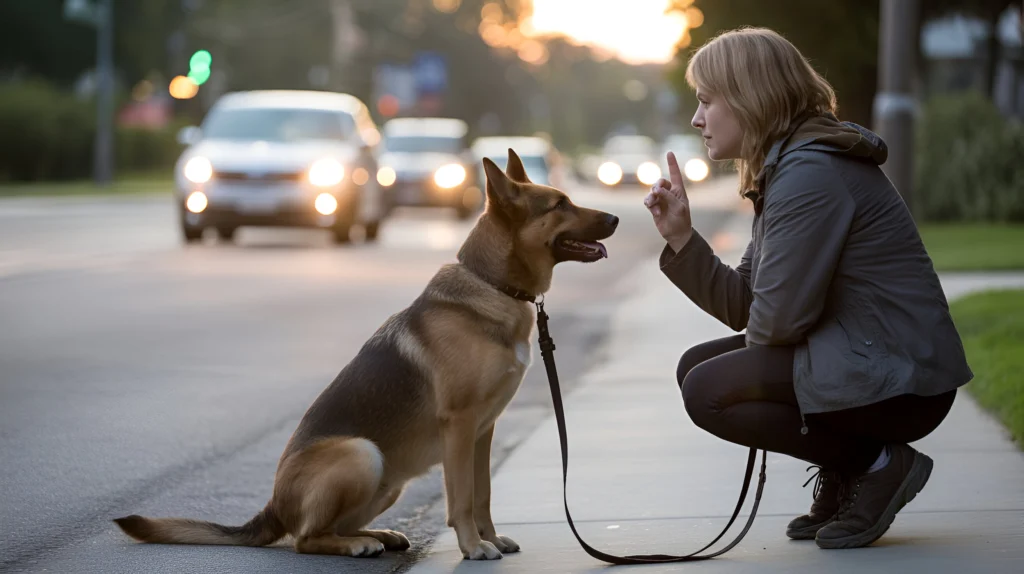
Randomly cue Bleib in daily life—mid-walk, at the car door, at a dropped snack. Reward like crazy. This is the rep that might save a life.
| Challenge | What to watch | Upgrade when |
| Out-of-sight | Ear flicks, tiny scoots | 3 clean reps in a row |
| Public patio | Soft eyes, loose jaw | Dog ignores waiter noises |
| Motion stay | Relaxed shoulders | You can circle your dog |
| Long-line park | Quiet tail, steady chest | Dog holds despite bikes |
| Emergency stay | Instant freeze | Dog freezes on first cue |
Keep saying the words out loud as you train—hearing yourself use stay in german dog commands reminds you to hold the same calm rhythm every time.

Common mistakes (and exactly how to fix them)
Mistake 1: Cueing “Bleib” repeatedly
Repeating the cue turns it into background noise.
Fix: Say “Bleib” once. Enforce with body language. If the dog breaks, quietly reset and retry at an easier level.
Mistake 2: No release word
Without a release, dogs guess when they’re done.
Fix: Pick one release (e.g., “Frei”) and use it every single time—even on easy reps.
Mistake 3: Jumping difficulty too fast
Home → busy park is a giant leap.
Fix: Change one variable at a time: duration or distance or distraction, not all three.
Mistake 4: Paying only with food
Food is great to start, but real life doesn’t always have treats.
Fix: Blend payments—praise, touch, and access to life rewards (door opens, ball rolls, walk resumes). That’s how stay in german dog commands becomes lifestyle, not a trick.
Mistake 5: Conflicting rules
If “stay” means “until released” at home but “just wait a second” outside, your dog will choose the easier rule.
Fix: Define your standard: release ends stay. Then defend that standard with kindness and consistency.
Emotional benefits and communication (what your dog actually feels)
When a dog holds Bleib, they practice stillness with you. That’s vulnerable and intimate. They listen with their whole body—their ears soften, their breath falls in sync with yours, and their eyes say, “I believe you’ll tell me when to move.”
That’s why stay in german dog commands is more than mechanics. It’s a ritual of co-regulation. Each successful rep tells your dog, “You are safe. Your patience matters. I’ll lead.” And you learn to communicate through posture, timing, and tone rather than volume or force.
I once worked with Luna, a rescue shepherd who panicked when her owner stepped away. We began with one-second Bleib while her owner leaned in and breathed with her. Two weeks later, Luna held a 15-second out-of-sight stay and wagged when her owner returned. We didn’t fix obedience; we rebuilt confidence through staying.
FAQ (real owner questions)
Q1: Can I mix English with German, like “Come” but “Bleib”?
Yes. Many handlers do. Just keep each cue consistent. If Bleib means stay, it always means stay.
Q2: My dog stays indoors but not outside—why?
New setting, new rules. Rebuild the ladder outside: short duration, short distance, easy distractions, then expand.
Q3: Is down-stay better than sit-stay?
For longer durations, yes. Platz + Bleib encourages relaxation. Use sit-stay for short, sharp control; down-stay for calm hangs.
Q4: What if my dog whines during stay?
That’s arousal. Lower difficulty, reward quiet moments, and lengthen after calm returns. Your tone matters more than your treats.
Q5: Where do Dutch dog commands fit in?
They’re common in KNPV traditions and can work beautifully. Pick one language system or be very deliberate about which cue belongs to which behavior.
Q6: How often should I practice?
Daily micro-sessions (2–5 minutes) beat weekend marathons. Sprinkle stay in german dog commands into your routine: doors, curbs, mealtimes.
Q7: What’s a good proofing milestone?
Your dog freezes on Bleib as a cyclist passes at 10–15 feet, then releases on your cue. That’s real-world reliability.
Final thoughts + key takeaways
When you strip away jargon, stay in german dog commands is a simple promise between two friends: I’ll be clear and patient; you’ll be brave and steady. You’ll have messy reps and magical ones; both count. Keep the ladder small, your tone soft, and your standard consistent. Use Sitz, Platz, and Bleib with heart. Pay with praise, freedom, and life rewards. Celebrate stillness as much as speed.
Key takeaways
- Clarity beats volume. Say “Bleib” once; mean it with your body.
- Release ends stay. Teach “Frei/Okay” and use it always.
- Ladder your progress. Duration → distance → distraction → new locations.
- Make it real. Practice at doors, curbs, patios, and parks.
- Train the feeling. Calm connection is the goal, not robotic stillness.
The day your dog holds Bleib as the world whooshes by, then explodes with joy on Frei, you’ll feel it: this isn’t control. It’s trust in motion—the kind of trust you build only when you speak a language that’s clear, kind, and consistent.